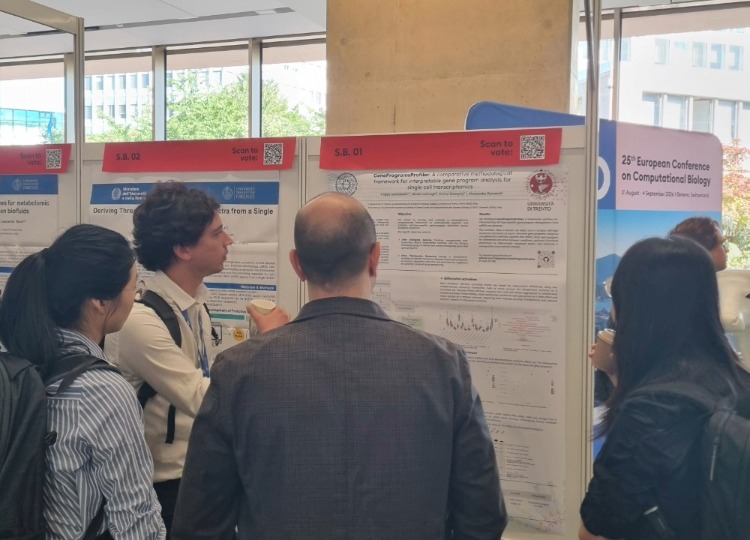
Poster at QSPC 2026
This month, COSBI participated in QSPC 2026, contributing to ongoing discussions on quantitative systems pharmacology (QSP) methodologies.
During the poster session, Elena Righetti and Federico Reali presented their work on virtual population generation, a key component in QSP modeling for capturing variability and supporting translational applications.
Their study compares optimization-based and surrogate-assisted approaches across multiple models, highlighting how methodological performance varies depending on model characteristics and computational constraints. Rather than identifying a universally optimal strategy, the work emphasizes that no single method consistently outperforms others across all scenarios.
A central outcome of the study is the importance of understanding trade-offs between goodness-of-fit, computational cost, and diversity when selecting a virtual population generation strategy. These considerations are essential for designing efficient, robust, and scalable QSP workflows, particularly as model complexity increases.
This contribution reflects ongoing efforts to refine computational methodologies and improve the reliability of model-based approaches in systems pharmacology.