A special moment at MAQC 2026 in Brescia
Event
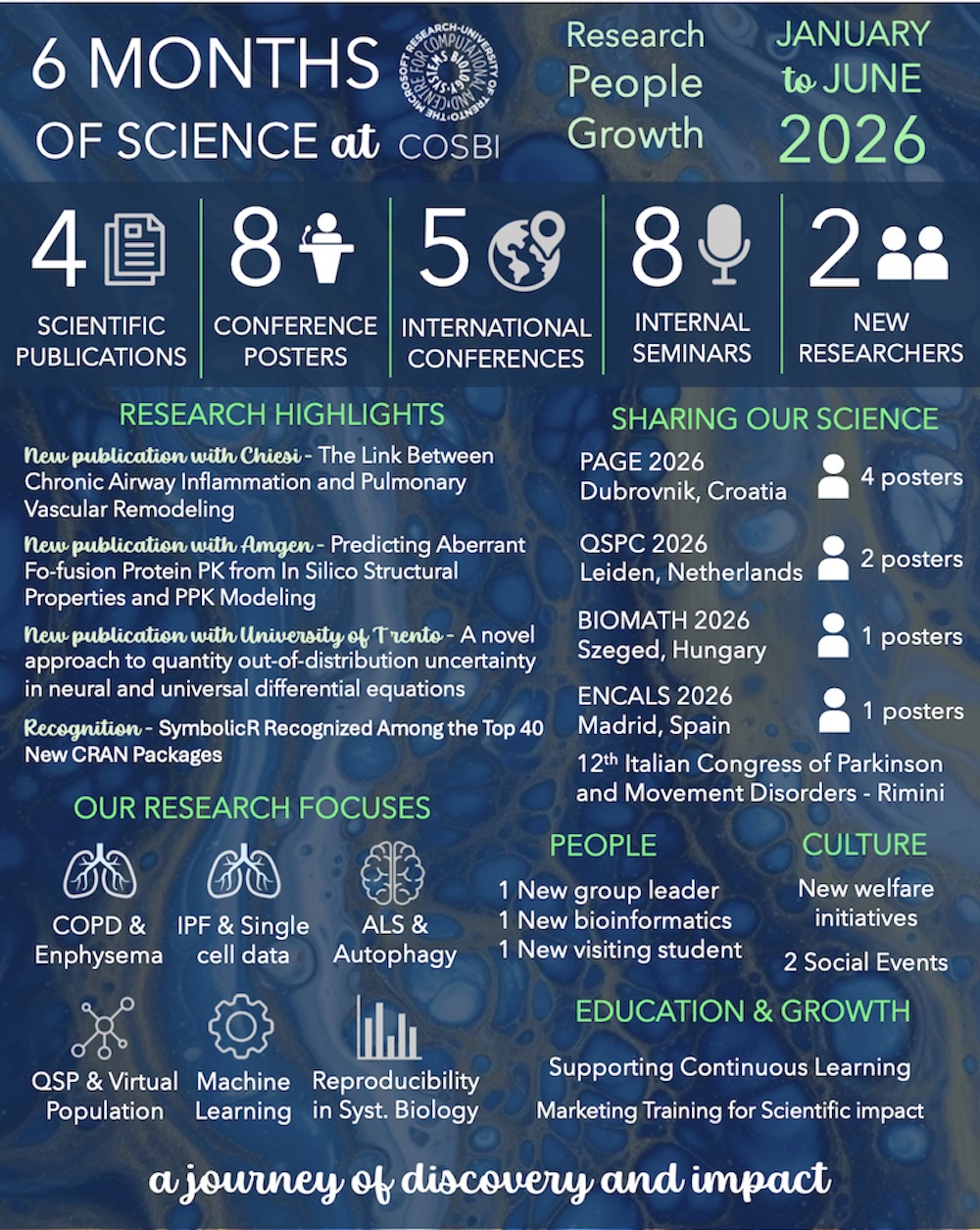
The first half of 2026 has been a period of continuous scientific activity and growth for COSBI. From new publications and international conferences to new team members, collaborations, and internal initiatives, the past six months reflect the institute’s commitment to advancing computational approaches for the life sciences while fostering a collaborative and stimulating research environment.
To capture this journey, COSBI has created a new infographic summarizing some of the key milestones achieved between January and June 2026.
Among the highlights are four scientific publications, eight conference posters presented at five international conferences, and eight internal seminars dedicated to sharing knowledge across different research areas. During this period, COSBI also welcomed new researchers to its team, strengthened collaborations with academic and industrial partners, and continued investing in professional development through training opportunities, scientific discussions, and new initiatives supporting its research community.
The infographic also showcases the diversity of COSBI’s research activities, spanning Quantitative Systems Pharmacology (QSP), PBPK modeling, neurodegenerative diseases, chronic respiratory diseases, machine learning, reproducibility, and single-cell transcriptomics.
Beyond scientific output, the first half of the year has been marked by initiatives aimed at strengthening the institute’s research culture, including the introduction of a new corporate welfare programme, continuous learning opportunities, and moments dedicated to team building and knowledge exchange.
Rather than celebrating individual achievements, this overview highlights the collective effort behind every publication, conference, seminar, and collaboration. Together, these activities contribute to COSBI’s mission of developing computational methods that support biomedical research and innovation.
As the second half of 2026 begins, COSBI looks forward to continuing this journey with new projects, collaborations, scientific contributions, and opportunities for growth.